Verified October 2026. This article is educational content, not financial advice.
Yes — you can open a U.S. bank account without a Social Security Number. Federal rules let banks verify your identity with a passport or other government ID, and many major banks accept an ITIN instead of an SSN when you open the account in person at a branch. Some immigrant-focused mobile banks and credit unions don’t require a tax ID at all. Here’s exactly which doors are open, what to bring, and which fees to watch.
A bank account is usually the first financial move a newcomer makes — it’s how you receive your paycheck, pay rent, and stop carrying cash. Get this right in week one and everything after it gets easier.
What the law actually requires (it’s less than you think)
Here’s the part most newcomers don’t believe: under federal Customer Identification Program rules, a bank opening your account only has to collect four things — your name, date of birth, address, and an identification number. That’s the whole list. And here’s the key part: if you’re not a U.S. person, that ID number does not have to be an SSN — or even an ITIN. The rule explicitly allows a passport number plus country of issuance, an alien ID card number, or the number of any other government-issued document showing your nationality or residence with your photograph on it.
It gets better: the rules even let a bank’s policy cover people who have applied for a tax ID but haven’t received it yet. So if your ITIN application is sitting in the mail, some banks can still open your account right now.
The catch? Those are the federal minimums — the floor, not the ceiling. Every bank stacks its own policy on top. One branch might welcome your passport and ITIN with a smile; another bank’s website may demand an SSN while its branches stay flexible. And policies change — so treat everything below as your starting map, and confirm with the bank before you apply.
What to bring to the branch
Walk in prepared and you’re out in 30 minutes. One rule: bring originals — photocopies usually won’t cut it:
- Valid foreign passport (your primary ID)
- ITIN letter from the IRS — if you have one (how the ITIN works)
- Proof of your U.S. address — lease agreement, utility bill, or an employer letter dated within the last 60 days
- Second photo ID if you have one — visa, driver’s license, or matrícula consular
- Initial deposit — often $25–$100 in cash or a check
No ITIN yet? Go anyway. Thanks to that “applied for a tax ID” exception, bring proof your ITIN application is in process — some banks can work with exactly that.
How to open a bank account in the USA without an SSN: step by step
Yes, you can open one — and the process is shorter than most newcomers expect. Here is the whole walk in order:
- Pick your path first. A major bank branch, an immigrant-focused mobile bank, or a credit union / Bank On account — the three paths above. If you want in-person help, choose the branch. If you want to open from your phone, choose the mobile bank.
- Call the branch before you go. Ask one exact question: “Do you open checking accounts with a passport and ITIN?” Policies vary branch to branch, and a five-minute call saves a wasted trip.
- Book an appointment. Walk-ins with unusual paperwork wait longer. An appointment gives the banker time to pull up the ITIN workflow before you arrive.
- Bring originals. Passport, ITIN letter if you have one, proof of US address dated within the last 60 days, a second photo ID if you have one, and your opening deposit (often $25–$100).
- Sign, deposit, and ask for your debit card. Most accounts open the same day. Ask the banker to walk you through the fee schedule before you leave — and ask what exactly waives the monthly fee.
Your three paths to an account
Path 1: A major bank, opened in person
On their websites, the biggest U.S. banks look like the strictest option — the online application almost always asks for an SSN. But walking into a branch is a different process entirely. Several major banks accept an ITIN instead of an SSN when you book an in-branch appointment: Bank of America, PNC Bank, Chase, and Citibank are the names that come up most often.
What actually works:
- Call the branch first and ask the exact question: “Do you open checking accounts with a passport and ITIN?” Don’t ask generally — policies genuinely vary from one branch to the next.
- Book an appointment instead of walking in. It gives the banker time to pull up the ITIN workflow before you arrive — walk-ins with unusual paperwork get slower service.
- Ask for a no-overdraft or low-fee account. Bank of America’s SafeBalance-style accounts (and similar products elsewhere) are built so you simply can’t spend money you don’t have — perfect while you’re still learning how U.S. banking works.
- Ask about international wires if you’ll send money home. Fees and exchange rates differ a lot between banks — and this is the question most newcomers forget to ask.
One more thing: a big-bank account pays off later. When you apply for a secured credit card, already being that bank’s customer can make the whole process smoother.
Path 2: An immigrant-focused mobile bank
If walking into a branch feels intimidating — or you’re still settling in and sorting life out — mobile banks built for immigrants let you open an account from your phone with documents you already have. Majority, for example, gives you a Visa debit card and an FDIC-insured mobile bank account with no SSN required: it takes a passport, matrícula consular, ITIN, driver’s license, immigration ID, or other government-issued photo ID, plus proof of U.S. residency. Membership is $6.99/month and throws in international calling and fee-free money transfers — features aimed squarely at newcomers.
The tradeoff is real: you pay a monthly membership instead of a bank fee you might get waived, and there’s no branch to walk into when something goes wrong. For a lot of new arrivals, though, the convenience wins.
Path 3: A credit union or Bank On account
Here’s something most newcomers miss: credit unions and community banks are often the most flexible of all. Some, like DC Credit Union’s SAFE Checking (designed for non-U.S. citizens), earn no interest — which means they legally need no tax ID at all. Just a foreign ID. Also look for Bank On accounts: certified low-fee, no-overdraft accounts whose standards strongly recommend accepting alternative IDs. They were built for exactly your situation — new to U.S. banking, watching every dollar.
Try searching “[your city] Bank On account” or “[your city] credit union immigrant account” for local options. Smaller institutions change their policies less often — and their bankers tend to know the ITIN process by heart.
| Path | ID accepted | SSN/ITIN needed? | Branch or online? | FDIC/NCUA | Best for |
|---|---|---|---|---|---|
| Major bank (branch) | Passport, ITIN | ITIN, or applied-for ITIN | Branch | FDIC | In-person help |
| Immigrant mobile bank | Passport, other government ID | No SSN required | Online | FDIC-insured partner bank | Opening from a phone |
| Credit union / Bank On | Foreign ID, alternative ID | No tax ID at some | Branch, some online | NCUA, or FDIC | Low-fee, no-overdraft |
Find a US bank account that fits your situation
Answer four short questions to see which accounts say they can work for your situation. We do not store or send your answers anywhere.
This tool gives general information only. It is not financial, legal, tax or immigration advice. Eligibility is decided by each bank and is subject to approval. Rules, fees and required documents change and can differ by account, state and branch. Always confirm every detail on the bank’s official website or with the bank before you apply.
Can you open an account online without an SSN?
Mostly no — and this is where newcomers burn the most time. The big banks’ online applications are built around SSN verification, and plenty of online-only banks will flat-out decline you without one. The branch is the flexible channel —
remember that. And if some online bank advertises “no SSN needed,” verify it’s real before you deposit a dollar: there should be
an FDIC-insured partner bank behind it, and a legitimate setup will name that bank openly.
Why do big-bank online forms fail? They are built around SSN verification: the form expects an SSN to check identity electronically, so without one it usually stops before a person can review other documents.
Which online routes actually work? The immigrant mobile banks covered in Path 2, which are designed to accept a passport or other government ID online. Before you deposit, use this checklist: the account must name an FDIC-insured partner bank openly, or walk away.
What to say at the branch — and what to do if they say no
If the banker hesitates, stay calm and specific. Say: “I am opening a checking account with my passport and ITIN. Can you open it under your Customer Identification Program process for non-US persons?” That sentence matters, because it points to the federal rule — not to a favour.
If they still say no, ask for the reason in writing and ask whether another branch or a different account type would work. A “no” at one branch is often a “yes” at the next one, because policies genuinely differ by branch.
There is one “no” that has nothing to do with your immigration status: your banking history. Before opening a new account, most banks check a report from a checking-account screening company — usually ChexSystems or Early Warning Services. If an old account was closed with an unpaid overdraft or unpaid fees, that record can get you denied.
That is not the end of the road. Under the Fair Credit Reporting Act, the bank must send you an “adverse action” notice naming the company that supplied the report. With that notice you can request a free copy of your report within 60 days — on top of the free copy you can already request every 12 months. If the report has an error, dispute it in writing with the reporting company and with the bank that supplied the information. The CFPB’s guide for people denied a checking account walks through these steps, and its sample letters help you write the dispute.
Two more things worth knowing before you go:
- Form W-8BEN. If you are a nonresident alien with no SSN or ITIN, the bank may hand you IRS Form W-8BEN. It certifies your foreign status for tax purposes — the bank keeps it on file, it is never sent to the IRS by you, and it is how the bank documents your account without a US tax ID. Fill it in honestly and ask the banker if anything on it is unclear.
- Second-chance accounts. If a screening report blocks you everywhere, ask for a lower-risk or second-chance account. Bank On certified accounts and many credit unions offer no-overdraft accounts designed exactly for people rebuilding their banking history.
Fees to watch before you sign
Here’s an uncomfortable truth: newcomers lose more money to fees than to anything else in banking. Before you accept any account, ask about these four:
- Monthly maintenance fee — usually $5–$15, often waived with direct deposit or a minimum balance. Ask what exactly triggers the waiver — this is the detail bankers sometimes gloss over. See the CFPB’s guide to checking account questions for more.
- Overdraft fees — typically around $35 per transaction. Yes, per transaction. A no-overdraft account kills this risk entirely.
- ATM fees — using another bank’s ATM can cost $3–$5 per withdrawal. Pick a bank with ATMs near your home and workplace.
- International wire fees — $25–$50 to send money abroad at big banks; immigrant-focused apps often include transfers free.
Read the fee schedule the banker hands you — actually read it, right there at the desk. If anything’s unclear, ask them to explain it in plain language. That’s literally their job.
Is your money safe? Understanding FDIC insurance
Deep breath — this part is reassuring. If the bank is FDIC-insured, your deposits are automatically insured up to $250,000 per depositor, per bank, for each account ownership category. No sign-up, no extra step, nothing to activate. Before you deposit anywhere, run the bank through the FDIC’s free BankFind tool. Credit unions carry the equivalent protection through the NCUA.
Two things FDIC insurance does not cover: investments (stocks, bonds, mutual funds, crypto) and whatever’s sitting in a safe deposit box. And if you use a fintech app instead of a bank, confirm exactly which FDIC-insured partner bank holds your deposits — the insurance follows the bank, not the app.
What a bank account won’t do for you
A checking account is step one — not the whole staircase. Here’s what surprises people: a bank account does not build your credit score. Checking activity simply isn’t reported to the credit bureaus. That’s why your next move in the first 90 days is a secured credit card that reports to all three bureaus — that’s the product that actually starts your U.S. credit history, as our 12-month credit starter plan walks through.
Debit cards for immigrants
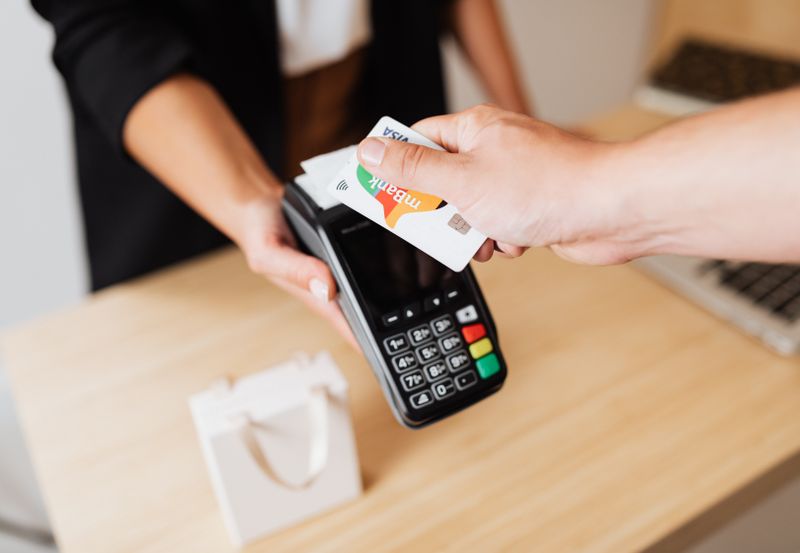
A debit card is not a separate account. It is the card linked to your checking account: it spends money already in that account.
When your account opens, the bank usually issues the debit card with it, by mail or at the branch, and you can use it at ATMs and for purchases. Using a debit card does not build credit, because checking activity is not reported to the credit bureaus.
Frequently asked questions
Do I need to be a U.S. citizen to open a bank account?
No. U.S. citizenship is not a requirement for opening a checking or savings account. Banks verify your identity and address — not your citizenship.
Can I open a U.S. bank account with just a passport?
Federal rules allow it: a passport number plus country of issuance is an acceptable ID number for a non-U.S. person. In practice, it depends on the bank’s policy — some credit unions and community banks accept a passport alone, while big banks usually want an ITIN as well. Call the branch first.
Do I need an ITIN before opening a bank account?
Not always. Some banks can open your account while your ITIN application is still processing, and some accounts (like non-interest-bearing credit union accounts) need no tax ID at all. Having an ITIN simply opens more doors — it’s worth applying early.
Which is better for immigrants: a big bank or a credit union?
Big banks offer huge ATM networks, multilingual apps, and international wire services — good if you travel or send money home. Credit unions and community banks usually offer more flexible ID policies and lower fees. Many newcomers start with a credit union for the easy opening, then add a big-bank account later.
Will opening a bank account affect my immigration status?
Opening a bank account doesn’t grant or change immigration status. Banks collect identity information to comply with banking law, not immigration law. If you have concerns about your specific situation, speak with an immigration attorney — this article can’t cover individual cases.
Can immigrants open online banking without an SSN?
Mostly no. Big-bank online forms are built around SSN verification, so they usually stop without an SSN. The branch is the flexible channel, or use an immigrant mobile bank that accepts a passport or other government ID online, and check that it names an FDIC-insured partner bank openly.
Do immigrants get a debit card with a US bank account?
Yes, usually. When your account opens, the bank usually issues a debit card with it, by mail or at the branch, for ATM access and purchases. A debit card spends money already in your checking account and does not build credit.
What if the bank denies my application for a bank account?
Ask for the reason in writing. Most denials come from a checking-account screening report (ChexSystems or Early Warning Services), not from your immigration status. The bank must send you an adverse action notice naming the reporting company. With it, you can request a free copy of your report within 60 days and dispute any error in writing. If one bank says no, try another — policies differ by branch, and lower-risk or Bank On accounts are built for exactly this situation.
What is IRS Form W-8BEN and do I need one?
Form W-8BEN is how a nonresident alien certifies foreign status to a US bank or payer. If you have no SSN or ITIN, the bank may ask you to complete it when you open the account. The bank keeps the form on file; you do not send it to the IRS. It is valid through the end of the third calendar year after you sign it, so it needs renewing if your situation has not changed by then.
Last reviewed: November 2026.
Sources
- CFPB’s guide to checking account questions
- FDIC — Understanding Deposit Insurance
- CFPB — Why was I denied a checking account?
- CFPB — Denied for a bank account? Here’s what you should know
- IRS — About Form W-8BEN
Related guides: Next, see How to Build Credit in the US as an Immigrant: The 12-Month Starter Plan, Secured Credit Cards for Immigrants: How the Deposit Works and When to Upgrade, and Cheapest Way to Send Money from the USA to Pakistan and India (2026 Comparison). Browse more Banking guides.